Stati Uniti d’America


Esportazioni di vino americano nel mondo – dati 2007

nessun commento

Fonte: www.wineinstitute.org
Gli Stati Uniti hanno avuto nel 2007 un anno molto positivo per le esportazioni di vino, ovviamente guidate dalla California, che rappresenta circa il 95% del totale. Il valore ha raggiunto il massimo storico di USD951m, pari a EUR614m usando il cambio attuale. Sempre poco rispetto a quanto si fa in Italia (circa EUR3.5bn) o in Francia (oltre EUR6bn), pero’ come potete notare dal grafico degli ultimi anni la progressione e’ molto chiara. Stiamo parlando di un incremento dell’8.5%, molto simile a quello italiano (circa 9%) e superiore a quello francese (+6%). In un’ottica quinquennale l’andamento e’ stato ancora piu’ positivo, con una crescita media annua del 12% circa. Va detto, a spiegazione del tutto, che la debolezza del dollaro contro praticamente tutte le valute del mondo ha favorito (e sta favorendo) le esportazioni americane nel mondo.

USA posted a very good year for wine exports, driven by California products, which represent roughly 95% of the total. In value, exports reached USD951m, or EUR614m. It is still lower than what Italy or France export (EUR3.5bn and EUR6bn), but as you can see from the first graph the progression over the past year has been significant. The increase was 8.5%, very similar to the 9% increase posted in Italy and better than the +6% of France. Looking more long term, in the last 5 years export CAGR touched 12%. All this is clearly helped by the weak USD which is favouring US goods exports.

usexp2007-1.jpg

Andiamo nel dettaglio: le esportazioni sono ammontate a 4.5m/hl, con un incremento del 12% rispetto al 2006. Tale incremento e’ in realtà superiore alla media annua degli ultimi 5 anni, che mostra una crescita del 10% circa dal punto di vista dei volumi. A questo si e’ quindi associato un leggero peggioramento del mix di vendita, che e’ passato da 2.16USD al litro a USD2.10 (EUR1.35). Ancora una volta, visto in un’ottica piu’ di lungo termine (secondo grafico) si puo’ apprezzare come il prezzo-mix delle esportazioni americane mostri un andamento leggermente positivo nel corso degli anni. Di nuovo a titolo di confronto, noi italiani esportiamo a EUR1.84 al litro, mentre i nostri amici francesi (anche grazie allo Champagne) viaggiano su uno stellare 4.3EUR al litro).

usexp2007-2.jpg

Volumes were 4.5m/hl, with a 12% increase vs. 2006. This is better than what posted in the last 5 years (10% compound). This implies a slight worsening of the mix in 2007, which moved from USD2.16 per liter to USD2.10 (EUR1.35). Once again, looking at a longer term graph you can easily see that the mix of US exports is gradually improving over the years. As a comparison, consider that Italian wine exports are carried out at an average of EUR1.84 per liter and French exports (also thanks to Champagne) at EUR4.3 per liter.

usexp2007-3.jpg

Vediamo dove esportano gli USA e come sono andati i diversi mercati. Beh, per tagliare corto potremmo dire che i mercati che hanno performato meglio sono quelli emergenti, mentre nei grandi mercati di consumo del vino le cose non sono andate cosi’ bene. E’ vero, in Europa (principale mercato con circa 2.6m/hl) i vini USA hanno perso il 3%, tutto per colpa di un 10% di peggioramento del prezzo mix, fatto molto strano in un anno in cui il dollaro ha giocato a favore. Vero invece e’ che in un mercato tanto interessante quanto il Canada (e noi italiani lo sappiamo molto bene), gli americani fanno un +23% con un +15% di volumi (0.8m/hl) e un +8% di mix (contro il nostro timido +3%). Gli americani esportano a USD2.9 al litro contro i nostri EUR3.6 (solo per i vini imbottigliati). Il prezzo mix in peggioramento del 16% e’ anche il principale commento da fare sul terzo mercato di esportazione, il Giappone, che copre circa 0.3m/hl di volume. Negli altri mercati le cose vanno a gonfie vele: il grafico vi mostra un bel balzo in Svizzera, che per importanza e’ ora il quinto mercato (considerando l’UE un mercato solo, naturalmente), in Corea e Cina, che ora sono il sesto e settimo mercato. In Cina gli USA esportano vino per USD16m, noi per EUR16m. Soltanto grazie al cambio EUR/USD a questo livello innaturale possiamo nascondere l’insuccesso del vino italiano in Cina…

usexp2007-4.jpg

Geographical break down. We might conclude that emerging markets performer well and developed markets not, but it would be not too precise. It is true that Europe was down 3% and this is the most important market for US wine exports with 2.6m/hl, due to a 10% worsening of the mix, which is quite difficult to understand given the benefit of the weak dollar. On the other hand, Canada performed very well with a 23% increase, of which 15% more volumes to 0.8m/hl and 8% better mix (vs +3% for Italian wine exports in Canada). US wine in Canada is sold at USD2.9 per liter vs. our EUR3.6. The price mix is also sharply worsening in Japan, with a -16%, which is the n.3 market for exports with 0.3m/hl. In the other markets the performance is by far better: Switzerland is up strongly and now is the market n.5. Korea and China are now n.6 and n.7. In China US are exporting wine for USD16m vs. our exports of EUR16m. Only thanks to the favourable USD rate we can say that we export more than US in this market…

Link del file con i dati/ File with data is here

Il costo di produzione del vino – studi universita’ USA 2003-2005

9 commenti

Negli Stati Uniti le università si occupano di compilare degli studi molto dettagliati che spiegano quali sono i costi di produzione dell’uva e, quindi, di una bottiglia di vino. Una specie di “costo sorgente” che non e’ (come si vorrebbe da noi) calcolato con l’obiettivo di scovare i viticoltori che guadagnano “troppo” (esiste?), ma bensi’ per guidare le scelte imprenditoriali di chi vuole mettere su un’azienda vinicola, per metterlo di fronte al costo iniziale di produzione. La statistica che vi propongo si riferisce al 2003 ed e’ relativo a un ettaro (abbiamo moltiplicato il costo di un acro per 2.47) di Cabernet Sauvignon in California. Quale e’ la principale conclusione? Che il costo vero da considerare nella produzione del vino e’ quello della terra, che rappresenta oltre la meta’ del totale, e che quindi i prezzi elevati di alcuni vini si giustificano con il valore elevato che viene dato alle terre sui quali sono prodotti…

In USA university are doing studies to explain which are the costs of producing grapes and wine. This is not to try to understand if farmers are generating extra return (as we would aim in Italy), it’s to make potential new farmers aware of what costs will they incur if they decide to set up a winery. The figures are based on 2003 dollars and are based on the production of 1 hectare (we translated from acres) of Cabernet Sauvignon in California. Which is the main conclusion? That the true cost of producing wine lies in the cost of the land, which is half of the total cost. As a result, the high price reached by some wines is justified by the very high value of the vineyard where its grapes are produced.

cosprod1.jpg

Lo studio elenca in modo molto dettagliato ogni trattamento e ogni operazione con l’indicazione dei costi. A noi forse interessa di piu’ avere un’idea dell’origine di questi costi. Secondo lo studio, un ettaro ha un costo vivo (cioe’ monetario) di circa USD13600, dei quali circa USD8600 sono relativi alle fasi di coltivazione e vendemmia, mentre i rimanenti USD5000 sono relativi ai costi amministrativi e assicurativi e, soprattutto, alle tasse (circa USD3800). In realta’, come vedete questi costi sono circa un terzo del totale, perche’ la gran parte e’ rappresentata dai costi non monetari, cioe’ dal costo di detenere la terra (quasi USD22000 nella simulazione) e dai costi impliciti di mantenere la struttura (un altro 15% del costo totale). Questo rende l’idea che il costo di coltivazione della vigna non e’ legato a quanto si spende per vendemmiare, ma piuttosto al capitale immobilizzato nell’azienda, sia esso il costo per affittare la vigna o la rata del mutuo o il costo “implicito” di aver investito in un pezzo di terra.
The study snows a very detailed list of treatment and the cost of each of them. We are more focusing here on putting them together in big categories. According to the study, 1 hectare has a cash cost of USD13600, of which USD8600 are for the cultivation and harvest and USD5000 are for G&A, insurance and tax (USD3800). More important, these costs are just a third of the total one as the two thirds are represented by implicit costs to maintain the structure and to own/rent the land (USD22000). This takes us to the conclusion that the cost to produce wine is not the cost to harvest but rather the capital employed in the firm, which is the cost of the land, eventually.

cosprod2.jpg

Nella seconda torta vedete anche quanto pesano i costi del personale addetto alla coltura e alla vendemmia sul totale: siamo intorno al 14% del totale (ovviamente con le assunzioni dello studio). Come dicevamo, il costo della terra e’ la meta’ del costo totale del prodotto finale, mentre un altro 35% se ne va tra tasse, costi di avviamento dell’azienda, remunerazione dell’imprenditore e costo dei macchinari.
In the second pie you can see how are the costs split by origin: personnel costs are in this simulation 14% of the total, while land is accounting for half of the total, with the remaining 35% split between tax, costs to set up the firm, to depreciate machinery and to remunerate the entrepreneur.

cosprod3.jpg

Un secondo esercizio che ho fatto e’ quello di cercare di tradurre questi numeri in costi per bottiglia. Potete quindi vedere quanto sarebbe il costo per bottiglia di una ipotetica produzione di un ettaro a Cabernet Sauvignon in California. Ho messo una tabella a diverse assunzioni di quintali per ettaro: nella zona 70-90q/ha, che e’ quella che contraddistingue le nostre produzioni di punta come il Barolo e il Brunello, arriveremmo a dei costi vivi per bottiglia tra USD1.8 e USD2.3, quindi relativamente bassi, ai quali pero’ vanno aggiunti USD5.4-7 di costi impliciti, che portano il costo della bottiglia tra USD7 e USD9. A rese molto alte 130q/ha il costo per bottiglia sarebbe significativamente piu’ basso a USD5.
A second exercise is to try to translate these figures into a cost per bottle. I did it based on a different yield levels. In the 70-90q/ha range, which is the most interesting one being the level of the top Italian wines, you would get to a cash cost per bottle between USD1.8 and USD2.3 and to a USD5.4-7 non cash cost level. In other words, the cost per bottle would be between USD7 and USD9. With higher yields you would reach a USD5 per bottle cost.

cosprod4.jpg

Infine, da un altro studio (questa volta su base 2003), abbiamo una serie di indicazioni in dollari per bottiglia di quanto pesano alcune componenti come i tappi, le bottiglie e le etichette e a quanto possono ammontare i costi di marketing e i costi generali. Vi prego di non sommare questi numeri a quelli precedenti, non c’entrano niente. Come potete vedere i costi di marketing possono arrivare a USD1.5 per bottiglia e la forchetta e’ molto ampia, da USD3.7 a USD8.6 per bottiglia.
Finally, another study takes care of giving some figures about the cost (2003 base) of certain items such as corks, bottles and labels and to what could be the weight of G&A and marketing costs. Don’t sum these figures with the previous ones, they are not consistent. As you can see, the range of these costs per bottle is quite wide, from a total of USD3.7 to USD8.6.

Valore, prezzi e tendenze negli Stati Uniti per vitigno – dati 2004

nessun commento

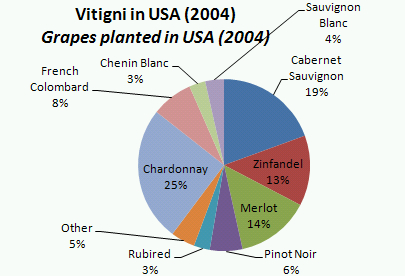
Questo post e’ costruito su una serie di dati per vitigno del mercato americano (ricavati da un articolo di Haeger/Storchmann) che ho trovato interessanti per una serie di motivi. Innanzitutto sono riferiti ai vitigni, e ci consentono di capire quali sono i rendimenti in dollari per ettaro dei diversi vitigni. Secondariamente, ci mostrano come la moda del Pinot Nero abbia portato i prezzi di questa uva alle stelle rispetto agli altri vitigni, nonostante, come e’ chiaro dallo studio, le temperature delle aree in cui e’ piantato sono ben lontane dal livello considerato ottimale per il vitigno (cioe’ quelle della Borgogna).

usavit1.jpg


This post is built on some data offered by a study of Haeger/Storchmann which I found interesting for a number of reasons. First, it shows the trend of different grapes in US and it shows what is the dollar revenues for each of them. Second, it shows how the Pinot Noir is highly valued vs. other grapes, although as the study underlines the temperatures of the area are clearly far from the optimal level for the grape (ie Burgundy).

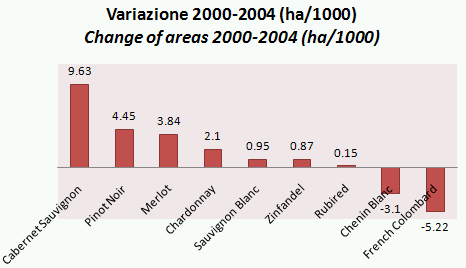
Questa torta vi indica la suddivisione del vitigno americano, dominato dallo Chardonnay (38k/ha nel 2004) e dal Cabernet Sauvignon (19% del totale). Come vedete il Pinot nero rappresenta soltanto il 6% del totale, ma dovete considerare che nel 1995 il vitigno era quasi non presente (3400ha contro i 9200ha del 2004). Quali sono i vitigni che crescono? Come vedremo, sono quelli che garantiscono degli introiti superiori: Cabernet Sauvignon, Merlot, Pinot Nero prendono il posto del Rubired, dello Chenin e del Colombard e soffocano lo Zinfandel e lo Chardonnay (stabili).

usavit15.jpg

The first pie showed you the breakdown of US vineyard by grape, with Chardonnay dominating with 38k/ha in 2004, followed by Cabernet Sauvignon (19%). As you can see Pinot Noir was just 6% of the total, but you should consider that in 1995 it was nearly not present (3400ha vs. 9200ha in 2004). Which are growing grapes: Cabernet, Merlot, Pinot Noir are replacing Rubired, Chenin and Colombard, while Zinfandel and Chardonnay are just flat.

usavit2.jpg

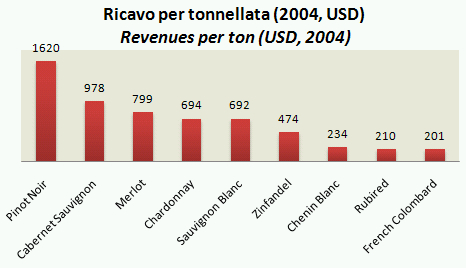
Come mai tutto questo interesse per il Pinot Nero? Per il prezzo di mercato delle sue uve, che come vedete nel 2004 era di ben 1600USD/ton, contro i 1000USD del Cabernet Sauvignon e gli 800USD del Merlot. Non a caso, questi tre vitigni sono quelli che abbiamo appena menzionato come quelli che crescono di piu’. Invece i vitigni in regressione come lo Chenin o la Colombard vedete che rendono meno di 250USD per tonnellata. Lo Zinfandel a 500USD e lo Chardonnay a 700USD si salvano mantenendo superfici stabili, il primo probabilmente grazie al fatto che e’ in parte considerato una sorta di vitigno autoctono per la zona.
Why all this interest for Pinot Noir? Because its market price is high. In 2004, it touched USD1600/ton vs. 1000 for Cabernet and 800 for Merlot. These three grapes are the ones growing more. Chenin and Colombard are below 250USD/ton, Zinfandel is at 500 and Chardonnay at 700 are just surviving, the first also thanks to the fact that it is felt as the real home grape in US.

usavit3.jpg

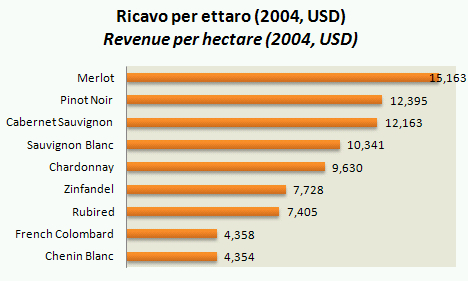
Prezzi per tonnellata moltiplicato resa… uguale ricavo per ettaro coltivato. E qui il Pinot Nero perde la sua leadership, superato dal Merlot, che si in maniera indiscussa il vitigno che ha garantito il massimo ricavo per ettaro a oltre 15000USD/ton. Poco sopra 12000USD trovate Pinot Nero e Cabernet Sauvignon.
Price per ton times yield… makes the revenue per hectare. And here Pinot Noir is losing its leadership as Merlot is showing a 15000USD/ton revenue vs. 12000USD for Pinot Noir and Cabernet Sauvignon.

usavit4.jpg

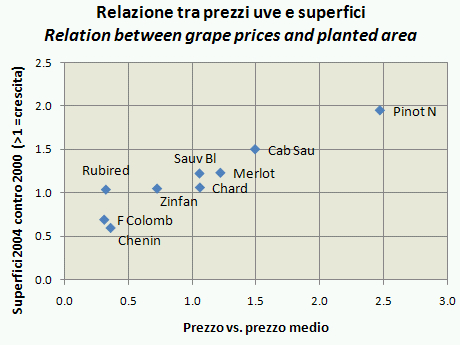
Questi valori sono esattamente lo specchio del trend della produzione, come potete vedere dal prossimo grafico che va un po’ spiegato: in orizzontale trovate il prezzo rispetto al prezzo medio, quindi trovate all’estrema destra il Pinot Nero e all’estrema sinistra i vari Colombard/Chenin/Rubired. L’asse verticale invece vi dice quanto sono le aree vitate del 2004 rispetto a quelle del 2000, quindi un valore superiore a 1 indica crescita delle aree (Pinot Nero sta a 2.5, che significa che nel 2004 c’erano 2 volte e mezza gli ettari del 2000). Non serve una linea di regressione per capire che il mercato americano si muove essenzialmente in relazione al ritorno sul capitale che viene garantito dal piantare un certo vitigno piuttosto che un altro. E forse, nei prossimi anni, non avranno pieta’ nemmeno per lo Zinfandel, anche se i 4°C di temperatura media che separano la Napa Valley dalla Borgogna forse significanto qualche cosa…
These values are exactly the mirror of the trend of areas, as you can guess from the last graph, which needs a bit of explanation. Horizontal axis you get the price vs. the average price, what is above 1 is above the average. Pinot Noir is therefore at the extreme right of the graph and in the left angle you see Colombard/Rubired/Chenin. In the vertical axis you see the ratio between areas in 2004 and in 2000. What is above 1 is growth. Again, Pinot Noir point is at 2.5 meaning 2.5 times the area in 2004 vs. 2000. You don’t need a regression line to guess that the American wine market is clearly following the return offered by different grapes. Maybe, in the coming years, they will even cut Zinfandel, even if the 4°C higher temperature of Napa Valley vs. Burgundy is maybe suggesting something about what wine comes out of the Pinot Noir.

Constellation Brands – risultati a fine novembre

nessun commento

Guardiamo oggi al trimestre piu’ importante dell’anno (al 30 Novembre) per Constellation Brands, il leader mondiale nel vino di qualita’, che ha fatto segnare dei risultati un po’ migliori di quelli dei trimestri precedenti, grazie a un recupero delle vendite in USA e una stabilizzazione in Oceania. Detto questo, va comunque sottolineato che il terreno di caccia di CBrands e’ diventata l’Europa. Nel grafico che segue vedete come dei USD977m di fatturato, USD183m siano in Europa con un progresso totale del 27% e “organico” (cioe’ escludendo le acquisizioni) del 4%. Questo e’ penso il messaggio piu’ importante che volevo trasmettere: l’Europa passa dal 13% al 18%. Per il resto, come vedremo, i margini si stanno stabilizzando intorno al 16% dopo un declino durato qualche trimestre e la societa’ sta integrando le acquisizioni (e nuove ne ha annunciato), con un graduale recupero degli utili.

constq31b.jpg

Constellation Brands posted Q3 results to 30 November showing a recovery vs. the performance of previous quarters, characterised by an improvement of US sales and a stabilisation in Oceania. That said, I think that the key issue to highlight here is that CBrands is starting to target quite heavily Europe. In the graph you can see, the turnover of USD977m is generated in Europe for USD183m, with a 27% jump in sales (4% organic). Therefore, Europe moves from 13% to 18% of sales of quality wine. Other messages from these results: margin is flattening in the region of 16% after a few poor quarters and the company is integrating new acquisitions with a gradual recovery of profits.

Continua a leggere »

Il mercato mondiale del vino – dati 2005 e stime 2010 – fonte: Vinexpo

nessun commento

Dopo aver analizzato i consumi di vino previsti nei prossimi anni, analizziamo il mercato del vino mondiale, cosi’ come lo vede Vinexpo di qui al 2010. Il valore al consumo del mercato del vino e’ di circa $107 miliardi, con una crescita del 2.4% annuo tra il 2001 e il 2005. Di qui al 2010, Vinexpo vede un +1.8% annuo che dovrebbe portare il mercato a $117bn. Questo 1.8% di crescita puo’ essere scomposto largo circa a meta’ tra i volumi e il miglioramento del prezzo-mix.

xpom1.jpg

After analysing the wine consumption for the coming years, we now report what Vinexpo expects for the wine markets in terms of value. The retail value of the world wine market was in 2005 $107bn, with a 2.4% yearly growth in 2001-05. For the 2005-10 period, Vinexpo sees a 1.8% annual growth, which should take the market value at $117bn. This 1.8% should be almost equally broken down between higher volumes and better price-mix.

Continua a leggere »