
[English translation at the end of the document]
Constellation Brands ha appena fornito una serie di dati molto interessanti sul mercato del vino americano, con numerosi dettagli soprattutto sulla segmentazione del mercato e sulle quote di mercato dei principali operatori. Il quadro e’ chiaramente positivo, con un paese con consumi di vino ancora limitati (circa 10 litri pro capite, ben al di sotto delle medie mondiali) e una forte propensione al consumo di vino di qualita’. Questo porta il mercato americano a essere un grande mercato (26m/hl di consumo di vino), ma soprattutto un mercato dove la parte di mercato (calcolata sul valore in dollari al dettaglio, di circa 28miliardi) del vino di qualita’ rappresenta circa i tre quarti del totale.
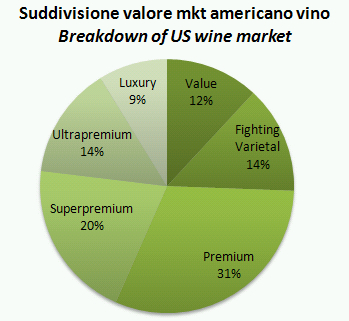
In realta’ gli americani vanno oltre il puro concetto di vino di qualita’, tema sul quale Aldo dedichera’ un po’ di lavoro. Si concentrano sulle fasce di prezzo. Quindi il vino da tavola e’ di due fasce: value, 12% del mercato e fighting varietal 14% del mercato. Come vedete il vino premium, che parte da 5$ alla bottiglia, ha poi altre fascie fino a 8$, poi fino a 11$, poi fino a 15$ e poi si arriva al luxury wine, tutto quello che cosa piu’ di $15. Come vedete la fascia tra 5 e 11$ rappresenta il 50% del mercato americano, mentre il 23% del vino si vende a oltre 11$ per bottiglia.
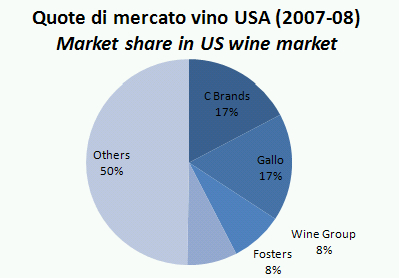
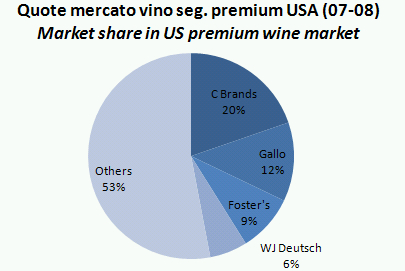
Il mercato e’ dominato da due operatori: Constellation Brands e Gallo, entrambi con circa il 17% del mercato. I primi 4 operatori rappresentano il 50% del mercato. Questo da’ una prima dimensione di forte consolidamento del mercato, cioe’ del fatto che questi operatori riescono a sfruttare grandi economie di scala nella distribuzione e nel marketing. Se passate al segmento premium del mercato, Constellation Brands diventa il chiaro leader, con Gallo che si focalizza di piu’ sul segmento sotto i 5$ e nella prima fascia del mercato premium. Con il 20% del mercato premium e una strategia chiaramente incentrata sul miglioramento del portafoglio verso la fascia alta dei prezzi, si puo’ dire che Constellation Brands e’ un leader indiscusso.
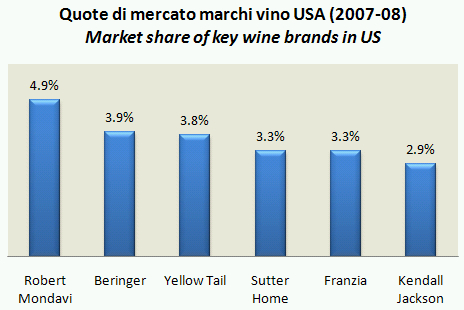
Infine, vi posto un po di dati sui principali marchi. Constellation Brands non e’ un marchio in se. Opera attraverso dei marchi, come Robert Mondavi, che e’ il principale brand nel mercato del vino americano con una quota di mercato vicina al 5%. Beringer, altro nome molto famoso, ha il 4% del mercato. Yellow tail ha una dimensione molto simile. I primi 5 brands fanno circa il 19% del mercato.
La considerazione finale e’ piuttosto semplice: i mercati con un numero di operatori limitato garantiscono profitti piu’ elevati. In particolare, riuscire ad avere delle quote di mercato importanti in fasce del mercato definite (e in tutte le fasce di mercato del segmento premium ad eccezione della fascia luxury, c’e’ qualcuno che ha piu’ del 20% della nicchia) garantisce controllo della distribuzione, economie di scala e, alla fine, un potere nella gestione delle campagne di marketing che contribuisce ad educare il consumatore per portarlo verso i segmenti premium del mercato.
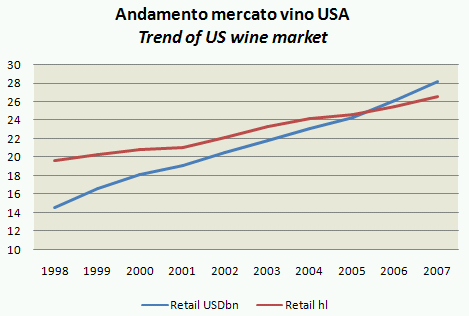
Constellation Brands has just provided some very interesting data on the American wine market, with many details especially on market segmentation and market shares of the main players. The framework is clearly positive: it is a country with a still limited wine consumption (about 10 litres per capita, well below the world average) and a strong tilt towards quality wines. This leads the American market to be a large market (26m/hl consumption of wine), but above all a market where the weight (calculated on the value in dollars retail, approximately 28bn USD) of quality wine is about three quarters of the total.
To be more precise, the Americans go beyond the pure concept of quality wine, a subject on which Aldo will focus in one of the next posts. They make further segmentation in price ranges. So the table wine is split in two segments: value, 12% of the market and fighting varietal 14% of the market. As you can see the premium wine starts from $ 5 bottle, then other bands are up to $ 8, then up to $ 11, then up to $ 15 and then there is the luxury wine, all that is above $ 15 . As you can see the range between 5 and $ 11 represents 50% of the American market, while 23% of wine is sold at over $ 11 per bottle.
The market is dominated by two operators: Constellation Brands and Gallo, both with around 17% of the market. The first 4 players account for 50% of the market. This gives a first idea of a consolidated market: these operators are able to exploit economies of scale in distribution and marketing. If we move in the premium segment of the market, Constellation Brands becomes the clear leader, with Gallo that focuses more on the market under $ 5 and the first segment of the premium category. With 20% of the premium wines and a strategy clearly focused on improving the portfolio towards high-end market price, we can say that Constellation Brands is an undisputed leader.
Finally, we provide a little data on leading brands. Constellation Brands is not a brand itself. It works through brands like Robert Mondavi, which is the leading brand in the U.S. wine market with a market share of close to 5%. Beringer, another very famous name, is 4% of the market (owned by Fosters). Yellow tail has a very similar size. The first 5 brands are approximately 19% of the market.
The conclusion is simple: a markets with a limited number of operators ensures more profits. In particular, being able to have market shares in well define market segments (and in all segments of this market with the exception of premium luxury segment, there is someone who has more than 20% share) ensures control distribution, economies of scale and in the end, a power in the management of marketing campaigns that helps to educate the consumer.


Mi piace la tua considerazione finale. Ci vorrebbe qualcuno in Italia che la facesse sua… 🙂
purtroppo siamo il paese del piccolo è bello, salvo poi farci colonizzare.
io per andare un pò fuori tema e fare arrabbiare il coautore, direi che Marchionne ha ragione + imprenditori e meno finanza 🙂