Fonte: Conseil des vins du Médoc
Il Medoc, cuore della produzione di Bordeaux, si sviluppa su 16400 ettari (15% del totale della regione). E’ interessante dare un’occhiata alle diverse denominazioni e alle loro dimensioni e rese degli ultimi anni. Le principali conclusioni sono: moderato incremento delle produzioni/aree, chiara leadership qualitativa delle AOC comunali e pesante calo delle esportazioni negli ultimi anni.
Medoc is the heart of Bordeaux wine production, with 16500ha, roughly 15% of the total of the region. It is interesting to analyse data for areas and production of the past 15 years. The key conclusions are: a slight increase in areas, a clear qualitative leadership of small AOC, a very weak performance of exports over the past 4 years.
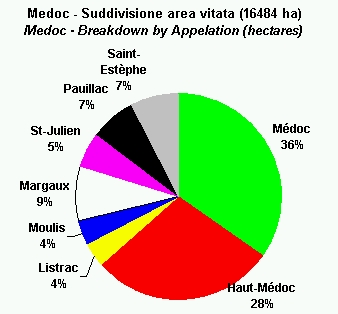
Partiamo subito col dire che e’ un’area in sviluppo nel mondo del vino, con una crescita di circa 1-1.5% annuo delle superfici dal 1990 (quando erano 13620 ettari) a oggi. Le grandi denominazioni che coprono i due terzi della superficie sono Medoc e Haut Medoc, e come vedremo sono anche quelle che mostrano le rese per ettaro piu’ elevate. Le famose denominazioni di Margaux (1422ha), St Julien (900ha), Pauillac (1200ha) e St Estephe (1233ha) sono relativamente piccole, diciamo di una dimensione paragonabile al Barolo (1700ha) o al Brunello (2000ha). The area of production is growing by 1.3-1.5% on a yearly basis from 1990 to 2005. The big appelation of Medoc and Haut Medoc are covering two thirds of the area and are the ones with the higher yields. The famous appelation of Margaux (1422ha), St Julien (900ha), Pauillac (1200ha) and St Estephe (1233ha) are quite small: their size is quite comparable with the Italian Barolo (1700ha) or Brunello (2000ha).
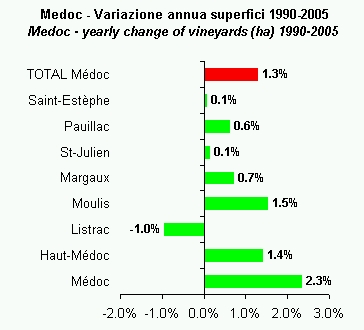
Vediamo ora come si muovono le superfici vitate: le 4 famosissime denominazioni comunali sono quasi completamente ferme, mentre crescono piu’ del valore medio dell’1.3% totale Moulis (1.5%), Haut Medoc (1.4%) e Medoc (2.3%). This is how areas are moving in the long term: the 4 very famous “appelation comunal” remain around flat, while the growth areas are Moulis (+1.5%), Haut Medoc (+1.4%) and Medoc (+2.3%).
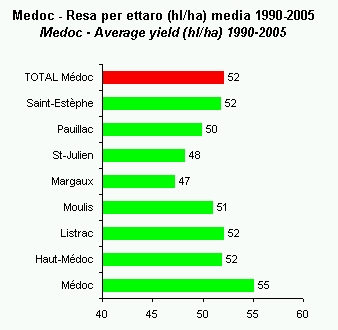
Rese per ettaro. Qui cominciamo a vedere qualche statistica piu’ interessante: dunque, Margaux (47hl/ha), St Julien (48hl/ha) e Pauillac (50hl/ha) sono sotto la media storica di 52 di tutta la regione. I grandi vini escono forse anche per questo motivo. Sono anche le denominazioni in cui, guardando la serie storica dal 1990 a oggi, c’e’ la maggiore variabilita’ nelle rese di anno in anno: Margaux in particolare ha una resa di 47hl/ha e una “variabilita’” di circa il 19-20% rispetto alla media di 52 e 17% rispettivamente. In altre parole si produce il 10% in meno con una volatilita’ delle vendemmie molto superiore.
Yields. Here we can see quite interesting figures. Margaux (47hl/ha), St Julien (48hl/ha) and Pauillac (50hl/ha) are all below the historical average of 52. The exceptional wines produced in these areas are not random. These are also the appelation where the production is more volatile. Margaux has a yield of 47hl/ha and a volatility of 19-20% vs. the 52 and 17% of the Medoc region respectively: this implies that in Margaux the production is on average 10% less with a higher volatility from year to year.
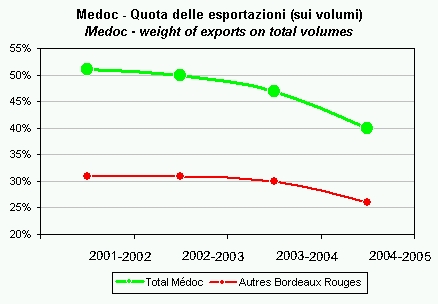
E’ tutto rose e fiori? Non proprio. Le esportazioni sono il principale punto debole della regione in questi ultimi anni, con valori in forte discesa per tutte le denominazioni. I vini del Medoc sono passati da oltre il 50% di quota export del 2001-02 al 40% del 2004-05, un calo molto piu’ significativo del 5% circa perso dagli altri vini di Bordeaux. E questo destino riguarda anche le grandi AOC comunali, dove le esportazioni sono passate dal 53% del 2001-02 al 45% di 4 anni dopo.
Is it all good? Not really. Exports is the key weakness of Medoc and more in general of Bordeaux region, with values strongly declining for basically all appelation. Medoc wines moved from 50% of export in 2001-02 to 40% in 2004-05, a decline much more significant than the -5% posted by other Bordeaux wines. This weakness can also be seen in the “AOC comunal” where they moved from 53% of exports to 45% 4 years later.
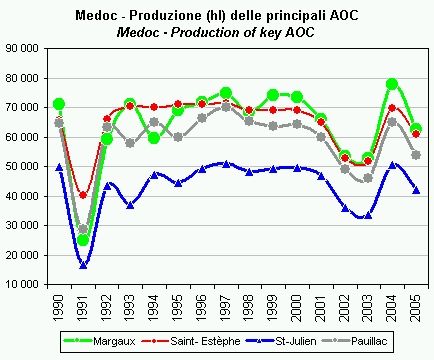
Ma quanto vino si produce mi chiederete? Questo grafico indica le produzioni delle principali denominazioni. Facendo delle medie sui 15 anni, potremmo dire che le denominazioni Margaux e St Estephe escono con 8.5-9m di bottiglie all’anno ciascuna, Pauillac sui 7.5-8m, mentre St Julien e’ sui 5.5-6m di bottiglie. Tutta la regione produce circa 750-800mila ettolitri (diciamo poco meno della Sardegna), per un totale equivalente di poco piu’ di 100m di bottiglie.
Wine production. The graph shows the production in hl of the key appelation. Looking at the average for the 15 years, the production of Margaux and St Estephe appelation are in the region of 8.5-9m bottles/year each, Pauillac is around 7.5-8m, while St Julien is at 5.5-6m bottles. All the Medoc region produces 750-800k hl of wine (slightly less than Sardinia to give a parameter), for a total of just more than 100m bottles.