
Laurent Perrier ci fa anche incamminare nel mondo dello Champagne con delle statistiche molto precise quanto aggiornate, che ho deciso di mettere in linea. Laurent Perrier is showing us several figures about Champagne sector with very precise and updated stats which I am to show you.
Partiamo con le spedizioni. Lo Champagne resta un prodotto prettamente francese, anche se a dire il vero la crescita viene trainata dalle sue vendite estere, che rappresentavano nel 2005 il 42% del totale. Nel 2006, l’ulteriore evoluzione porta le esportazioni al 44%. Francia +1/2% all’anno export +5/10%. Nel 2006 ne sono state spedite 321.6m. Sales. Champagne is still mainly a French product, although growth is mainly achieved outside France. In 2005 France was 58% of sales, declining to 56% in 2006. All in all, French sales are growing 1-2% a year, export is up 5-10% on a yearly basis. In 2006 deliveries reached 321.6m

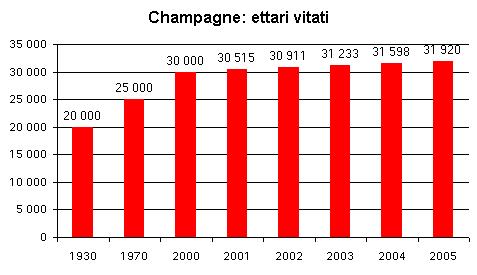
Ettari vitati. Sono in costante crescita e hanno raggiunto i 32000 ettari nel 2005, con una crescita molto lenta ma costante negli ultimi 4-5 anni dell’1-1.5% circa. Ad oggi, le aree vitate a CHampagne sono circa il 50% piu’ alte di 70 anni fa.
La Champagne e’ il 5.6% del vitigno francese AOC e il 3.5% del vitigno totale. E’ diviso in 274000 parcelle (!!!!), 323 crus e 15187 coltivatori che controllano il 90% delle aree (il restante 10% e’ nelle mani delle cosiddette “Champagne houses”).
Areas. They are costantly growing at a rate of 1-2% and reached 32000ha in 2005, Today, there are 50% more vineyards under Champagne AOC than in the Thirties.
Champagne AOC is 5.6% of AOC vineyards in France and 3.5% of total vineyards. It is split in 274,000 single parcels, 323 crus and 15187 growers are controlling 90% of the area, the other 10% being in the hands of Champagne houses.
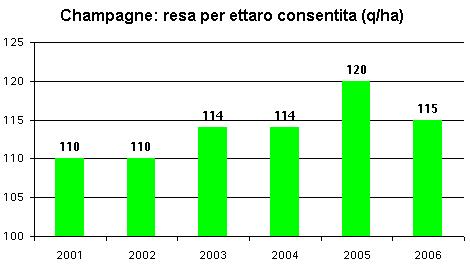
Rese per ettaro. Ogni anno le rese sono definite dal consorzio. Il grafico mostra le rese massime per ogni annata, che stanno tra 110 e 120 q/ha. Va poi detto che c’e’ un rilevamento del prezzo medio di vendita delle uve, che nel caso dello Champagne e’ stato regolamentato fino al 2003 (circa 400-425 euro per quintale). Dal 2004 e’ libero ed e’ variato tra 410 e 496 Euro al quintale per le uve 100% graded, cioe’ quelle potenzialmente utilizzabili per produrre i Cru.
Yields. The maximum yield is defined every year by the consortium. The graph shows that max yields are between 110 and 120q/ha (quite high I would say). It is then to be specified that up to 2003 the price of grapes was set by the regulator and ranged between 410 and 425 per q (at least in 2001-03). Then it was liberalised and is now ranging from 410 to 496 EUR/q for a 100% graded grape (ie the ones eligible to produce a cru).
Infine una nota curiosa. Laurent Perrier dichiara che per fare una bottiglia di Champagne sono necessari 1.2kg di uva. 4.5 Euro al chilo x 1.2 fa 5.4 euro. Questo e’ se volete, il costo della materia prima contenuto in una bottiglia di Champagne.
Finally a curious note: Laurent Perrier declares that to produce a bottle of Champagne ou need 1.2kg of grapes, at 4.5 EUR per kilogram. It makes 5.4EUR per bottle represented by the cost of the raw material…

